Showing posts with label Isro. Show all posts

Thursday, September 1, 2011

ISRO to build new class of powerful communication satellites!

For LEED Consultancy / IGBC Certifications, Green Building Design, Green Homes, Green Factory Buildings, Green SEZs, Green Townships & Energy Audits - www.greentekindika.com

Courtesy:    Press Trust Of India / ibnlive.in.com/ Updated Aug 31, 2011 at 06:03pm IST.

Bangalore: The Indian Space Research Organisation (ISRO) plans to build a new class of powerful communication satellites that packs more capacity and new technologies, its Chairman K Radhakrishnan said in Bangalore on Wednesday.
This kind of spacecraft would handle larger amount of power and accommodate more number of transponders in the same satellite, he said, adding ISRO planned to incorporate new technologies in them and get into higher bands.
"Today, we are at Ku band. We want to get into Ka band and even higher band. This is one of the priorities (in the coming five-year plan (which starts in April next year)", Radhakrishnan, who is also Chairman of Space Commission and Secretary in the Department of Space, said.
IBNLive
"In remote sensing (satellite field), we have to get into environmental studies and climate change studies. This is one requirement, new requirement (in the next five-year plan)," he said.
He said the Bangalore-headquartered ISRO would launch its first navigation satellite next year, under its Indian Regional Navigation Satellite System (IRNSS) programme which would be followed by six more such spacecraft. "So, these will have live coverage over Indian region," Radhakrishnan said.
ISRO's GSLV today can carry satellites weighing 2.2 tons into space. Radhakrishnan said GSLV-Mk III (which can lift four tonne spacecraft) is going to be one of the "major targets" in the coming five-year plan.
Radhakrishnan emphasised that the first and foremost priority of the ISRO was flying indigenous cryogenic engine and stage.
"That's (cryogenic technology) the future for ISRO because future launch vehicles will require cryogenic engine and stage," he said.
ISRO's earlier attempt in April 2010 to flight test the home grown cryogenic engine and stage, a complex technology, had ended in failure when the launch vehicle veered off its path and plunged into the Bay of Bengal along with GSAT-4 satellite.
Radhakrishnan also said ISRO was now going to make a "very major inroad" in science, and referred to Astrosat, a multi wave-length observatory in space, which it plans to launch in the next financial year.
He stressed the need to build "sufficient number of scientific talent" to utilise the space-based data generated by ISRO's satellites.
            
"Space exploration not only gives you excitement, it drives the technology downstream," he observed.

Saturday, July 16, 2011

INDIAN SPACE FORAYS:ISRO-developed computer helped PSLV-C17 put satellite in orbit!

Download your free copy of “My First Beer” Now with the Smashwords Summer/Winter promotion, ending July 31, 2011

T.S. SUBRAMANIAN / The Hindu / SRIHARIKOTA (AP), July 15, 2011.

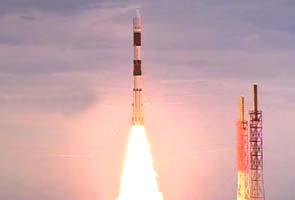
The PSLV-C17 carrying latest communication satellite GSAT-12 was successfully launched from Satish Dhawan Space Centre, Sriharikota on Friday. Photo: K. Pichumani
The PSLV-C17 carrying latest communication satellite GSAT-12 was successfully launched from Satish Dhawan Space Centre, Sriharikota on Friday. Photo: K. Pichumani - The Hindu.

Vikram has indigenous processors both in primary and standby mode
“One of the achievements” of the successful Polar Satellite Launch Vehicle (PSLV-C17) mission that put the communication satellite GSAT-12 in orbit on Friday was that it used an indigenous computer, Vikram, with advanced software in the rocket's navigation, guidance and control systems, said K. Radhakrishnan, Chairman, Indian Space Research Organisation (ISRO). This advanced mission computer helped the rocket put the satellite accurately in orbit.
Mr. Radhakrishnan told a press conference here that the ISRO-developed Vikram had indigenous processors both in the primary and standby mode. The ISRO had tested the indigenous software and only after it was found flight-worthy, was it used in the mission.
T.K. Alex, Director, ISRO Satellite Centre, Bangalore, said the coming days would be “interesting” because commands would be given from the Master Control Facility (MCF) at Hassan, Karnataka, to the liquid apogee motor (LAM) on board the GSAT-12 to take the satellite from its present sub geo-synchronous transfer orbit (GTO) to a circular geo-synchronous orbit at an altitude of 36,000 km. Dr. Alex was confident that the ISRO would do this with the experience gained from the Chandrayaan-1 mission in 2008, “which was almost similar” to the GSAT-12 mission.

Full Story at,

Friday, July 15, 2011

INDIAN SPACE FORAYS: PSLV rocket launches communications satellite!!

Download your free copy of “My First Beer” Now with the Smashwords Summer/Winter promotion, ending July 31, 2011

NDTV Correspondent, Updated: July 15, 2011 17:19 IST.


Sriharikota:  Scientists at the Indian Space Research Organisation (ISRO) in Sriharikota have launched a new communications satellite using the smaller of their rockets, the Polar Satellite Launch Vehicle (PSLV).

The transponders on the satellite, G-SAT12, will be used for education, telephone and telemedicine services. It weighs 1410 kgs and costs 80 crores. India is short of transponders, and today's mission, if successful, could add 12 C-band transponders.  

The PSLV, worth 90 crores, has established itself as a workhouse rocket - this is its 19th mission. It's considered complex and unique because it entails five special orbital manoeuvres.  The PSLV has to ensure that the satellite is injected into the correct geo-synchronous orbit - that will take a few days.


Full Story at,

Saturday, July 9, 2011

INDIAN SPACE FORAYS: ISRO mulls taking foreign satellite on rent!

For US-LEED, LEED India, IGBC Green Homes, Green Factory Buildings, Green SEZs, and Green Townships: www.greentekindika.com
Have you read, “Mayhem of the Miserables!” available @ US$ 1/- with the Smashwords Summer/Winter promotion, ending July 31, 2011

PTI / The Hindu / BANGALORE, July 9, 2011.
Polar Satellite Launch Vehicle (PSLV) C-16 blasts off carrying RESOURCESAT-2, YOUTHSAT and X-SAT satellites from the Satish Dhawan space centre at Sriharikota in this April 20, 2011 photo.
Polar Satellite Launch Vehicle (PSLV) C-16 blasts off carrying RESOURCESAT-2, YOUTHSAT and X-SAT satellites from the Satish Dhawan space centre at Sriharikota in this April 20, 2011 photo - The Hindu.

Faced with transponder capacity crunch, ISRO is exploring the possibilities of taking “on rent” a foreign satellite for a couple of years and acquiring more foreign transponders on lease.

Indian Space Research Organisation at present has 175 transponders in a mix of C, Extended—C, Ku and S bands and has taken on lease 86 and half foreign transponders but faced a huge order book position.

At the beginning of the 11th plan in April 2007, ISRO had 211 transponders and the goal then was to take it about 500 by March 2012 but a combination of unsuccessful missions, premature terminations and some satellites entering the end of their normal life led to it ending up way below the mark.

ISRO sources said the required demand now is about 200 transponders in all and it’s scouting to meet that demand by acquiring more foreign transponders for a short period till its own new satellites are launched and become operational.

ISRO Chairman K. Radhakrishnan said the Indian space agency is also exploring “if we could get a (in—orbit) foreign satellite moved into our (designated, orbital) slots for a short period.

“We have got several orbital slots. We could go up to 320 transponders,” he told a press conference.
Sources said ISRO currently has a huge order from users such as DTH broadcasters, VSAT operators and there is also growing demand from applications such as disaster management support.


Full Story at,

INDIAN SPACE MARKETING: ISRO names full-time CMD for Antrix!

For US-LEED, LEED India, IGBC Green Homes, Green Factory Buildings, Green SEZs, and Green Townships: www.greentekindika.com
Have you read, “Mayhem of the Miserables!” available @ US$ 1/- with the Smashwords Summer/Winter promotion, ending July 31, 2011


ISRO names full-time CMD for Antrix - Reuters
ISRO names full-time CMD for Antrix - Reuters.

Indian Space Research Organisation (ISRO) today named Dr V.S. Hegde, a veteran remote sensing applications scientist, as the Chairman-cum-Managing Director for its marketing arm Antrix Corporation Limited.
Hegde has served Bangalore-headquartered ISRO as its Scientific Secretary since January 2010, and previously played a key role for several years in its earth observation satellite (EOS) programmes.
His appointment, announced by ISRO Chairman K. Radhakrishnan, is part of plans to restructure Antrix in changing times so that it can aggressively exploit commercial opportunities emanating out of the space agency's programmes.


Full Story at,

Friday, July 8, 2011

INDIAN SPACE CAPABILITIES: Isro to have reusable launch rocket in 2 yrs!

For US-LEED, LEED India, IGBC Green Homes, Green Factory Buildings, Green SEZs, and Green Townships: www.greentekindika.com
Have you read, “Mayhem of the Miserables!” available @ US$ 1/- with the Smashwords Summer/Winter promotion, ending July 31, 2011

July 8, 2011 / By B.R. Srikanth, Correspondent, Bengaluru / DC.


Indian space scientists are designing a new genre of rockets and their variants, including a re-usable one, to hoist heavy satellites into space.
One such project involves integration of semi-cryogenic and cryogenic engines along with boosters to launch satellites weighing up to six tons, says Dr K. Radhakrishnan, chairman, Indian Space Research Organisation (Isro). “We are in the process of developing a high thrust engine. Our vision is to have a unified launch vehicle with a semi-cryogenic lower stage, and a cryogenic upper stage along with strap-on boosters. It will be used for different masses of payload, and designed to launch up to six tonnes,” he said.

Full Story at,

Thursday, June 9, 2011

India's in News: Prithvi-II successfully test-fired

Have you read, “Mayhem of the Miserables!” available @ http://www.smashwords.com/books/view/52075

Representative image - Agencies
Representative image - Agencies.

India today successfully test-fired its nuclear capable Prithvi-II ballistic missile from the Integrated Test Range at Chandipur near as part of the user's trial by the Army.
"The indigenously developed missile mounted on a mobile launcher was test-fired from the launch complex-3 in the ITR at around 0905 hours and the trial was fully successful", defence sources said.
"Earlier also, Prithvi-II missile had proved its robustness and accuracy repeatedly during many trials," a Defence Research and Development Organisation (DRDO) official said. "Taken from routine production lot during earlier user’s trials by Indian Army, the missile had achieved single digit accuracy reaching close to zero circular error probability (CEP)," the sources said.

Good Work, DRDO!

Full Story at,

Sunday, May 22, 2011

Indian Space Capabilities: Ariane-5 launches India's GSAT-8 from French Guiana!

Brickbats, Bouquets & Backfeeds are welcome on prmadhura@yahoo.com

Vaiju Naravane
ISRO's facility at Hassan confirms reception of signals

- PHOTO: AFP/ARIANESPACE 
PERFECT TWO:The Ariane 5 rocket, carrying two telecommunications satellites ST-2 and GSAT-8, takes off from its launch site in Kourou on Saturday.

Guiana Space Centre, Kouru: It was a perfect launch. At exactly 2.08 a.m. IST on Saturday, Ariane-5, the 800-tonne launcher, carrying two communications satellites weighing over 9,000 kg in its nose fairing, blasted off into space.

India's GSAT-8 — the largest and heavies satellite built by the Indian Space Research Organisation (ISRO) and its partners — was one of the two “co-passengers” on the flight. The other, an even heavier satellite weighing five tonnes, was from Singapore and Taiwan.

Although the launch window was 90 minutes long, the countdown began on the dot at 17.38 local time and on the word “top” from the Jupiter Control Room, the cryogenic main engine was ignited. Just 7.05 seconds later the booster rockets roared into life each containing 250 tonnes of dry powder that gave a thrust of 13,000 tonnes.

Full Story at,